Sniffing the Cosmos: How Your Dog's Nose Is More Advanced Than NASA's Best Detection Technology

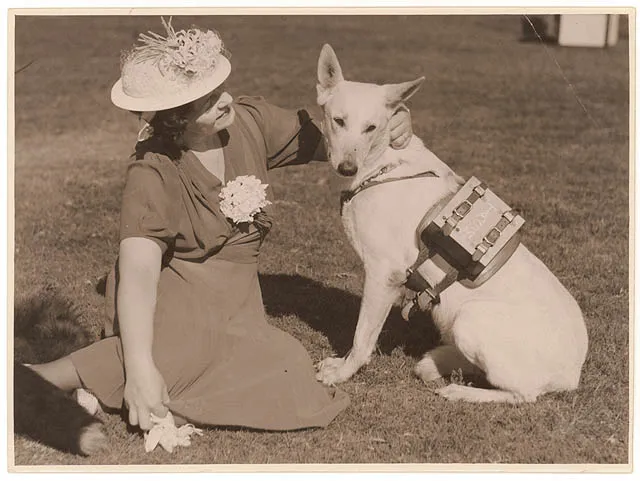
Photo: Pittigrilli, CC BY-SA 4.0, via Wikimedia Commons
There is a moment, familiar to every dog owner in America, when your dog lifts their nose to the breeze and their entire body transforms. The eyes go soft. The ears pivot forward. The tail stills. They are receiving information on a frequency you cannot access, processing a world of chemical data that you will never, not once in your entire life, be able to perceive.
You probably thought: that's cute.
NASA thought: we need to study this.
The canine nose is one of the most sophisticated biological detection instruments on Earth, and for several decades, space agencies, defense researchers, and astrobiology scientists have been quietly paying very close attention to it. What they've found has implications not just for how we understand dogs, but for how we might one day find life — or danger — in the furthest reaches of space.
The Numbers Are Genuinely Staggering
Let's establish some baseline facts before we go interstellar, because the raw biology here deserves a moment of appreciation.
Humans have approximately 6 million olfactory receptors in their nasal cavities. That sounds like a lot until you learn that the average dog has between 220 million and 300 million, depending on the breed. A Bloodhound clocks in at roughly 300 million. The part of a dog's brain devoted to analyzing scent is, proportionally, about 40 times larger than the equivalent region in a human brain.
Dogs can detect certain compounds at concentrations as low as one part per trillion. To put that in terms that mean something: that's the equivalent of detecting a single drop of a substance diluted into 20 Olympic-sized swimming pools. They can smell the passage of time in a scent trail — detecting which end of a footprint path is newer than the other based on the rate of chemical decay. They can identify individual humans by scent with accuracy that outperforms DNA testing in certain conditions.
They can smell cancer. They can smell seizures before they happen. They can smell fear, which you already knew because your dog has definitely clocked your pre-vet-appointment anxiety from across the house.
What Space Agencies Actually Found
NASA's interest in canine olfaction didn't begin with some whimsical "what if dogs were astronauts" brainstorming session. It began, as most serious science does, with a problem.
Deep space missions require extraordinarily sensitive chemical detection systems. Detecting trace gases in planetary atmospheres, identifying signs of biological activity in extraterrestrial environments, and monitoring air quality in sealed spacecraft habitats all demand detection capabilities that our best electronic sensors have historically struggled to match. The search for biosignatures — the chemical fingerprints of life — on Mars or Europa or Titan requires finding needle-in-a-universe-haystack concentrations of specific compounds.
Canine olfaction kept coming up as a benchmark. Not as a literal solution — you cannot, for logistical and ethical reasons that should be obvious, deploy a Labrador on a Mars rover — but as a biological proof of concept. If evolution produced a detection system this sensitive in a mammal, what can that system teach us about building better artificial detectors?
Researchers at NASA's Jet Propulsion Laboratory have studied the physical architecture of the canine nasal system to inform the design of next-generation chemical sensors. The dog's nose has a specific airflow mechanism that separates incoming air into two streams: one for breathing, one for scent analysis. This means a dog never has to choose between breathing and smelling — the two processes run in parallel, with scent molecules being continuously cycled through the olfactory epithelium even during exhalation. It's a masterpiece of biological engineering, and JPL engineers have worked to replicate aspects of this dual-stream architecture in prototype atmospheric sensors intended for planetary exploration.
The Electronic Nose and Its Canine Inspiration
The field of machine olfaction — the development of artificial "electronic noses" — has been explicitly shaped by canine biology for over thirty years. Early e-nose technology was clunky and limited, capable of detecting only a narrow range of compounds with modest sensitivity. The gap between what a dog could smell and what a machine could detect was, for a long time, embarrassingly large.
That gap has been closing, and the dogs deserve partial credit.
Researchers at institutions including MIT, Caltech, and several NASA-affiliated labs have used detailed mapping of canine olfactory receptor proteins to design synthetic receptor arrays that mimic the biological originals. The diversity of receptor types in a dog's nose — each tuned to respond to different molecular structures — is what gives them their extraordinary range. Modern e-nose arrays attempt to replicate this by using hundreds or thousands of different sensor types in parallel, each responding to a slightly different chemical signature.
The applications for space exploration are significant. The European Space Agency has tested e-nose technology aboard the International Space Station to monitor cabin air quality and detect potential equipment failures through chemical signatures before they become critical. NASA has incorporated similar systems into planetary rover design proposals. The underlying logic of these systems traces directly back to studying how a Beagle processes a complex scent environment.
Astrobiology's Most Unexpected Consultant
Here's where things get genuinely cosmic. Astrobiology — the science of searching for life beyond Earth — has a fundamental challenge: we don't entirely know what extraterrestrial life would smell like, chemically speaking. We assume it would produce some form of biosignature gas, some metabolic byproduct that differs from purely geological chemistry. But the specific compounds and their concentrations are uncertain.
Dogs have been used in research to help understand the outer limits of what biosignature detection might require. Studies examining how dogs detect cancer biomarkers — volatile organic compounds present in breath, urine, and tissue at extraordinarily low concentrations — have directly informed the sensitivity benchmarks that astrobiologists set for their detection instruments. If we want a Mars probe to detect signs of microbial life, we need to know how faint that chemical signal might be. The dog's cancer-detection work has helped calibrate those expectations.
Some researchers have gone further, proposing that the biological principles behind canine olfaction could inform the design of detection payloads for future missions to ocean worlds like Europa or Enceladus, where any life would likely be chemosynthetic — living off chemical reactions rather than sunlight — and identifiable primarily through trace chemical signatures in the water or ice.
Your dog, in other words, is not just sniffing the neighbor's garbage. They are demonstrating the biological principles that may one day help us find life on an ice-covered moon of Saturn.
Living With a Biological Wonder
So what does any of this mean for you, standing in your backyard at 7 a.m. while your dog spends four full minutes sniffing a single blade of grass?
It means you are watching something extraordinary. That grass blade is telling your dog a story — who walked by, when, what they ate, what they were feeling, whether they were healthy. Your dog is reading a chemical newspaper that you cannot see, written in a language that has taken evolution millions of years to develop and that human engineers are still, with all our technology, only beginning to approximate.
The cosmos is full of information. Light carries it across billions of light-years. Radio waves carry it through the vacuum of space. And here on Earth, in the quiet chemistry of the morning air, your dog is receiving transmissions from a world that exists just beneath the threshold of human perception.
Give them a moment. The universe is talking, and they're the only ones in your household who can hear it.